Learn Pin From Failures
Self-referential struct
#[derive(Debug)]
struct Foo {
    // In somewhat way, we establish the invariant:
    // `a` always points to itself. i.e. `a` represents the start
    // memory address of current Foo instance
    a: *const Foo,
    b: u8,
}
We can initialize the raw pointer with std::ptr::null.
impl Foo {
    fn new(i: u8) -> Foo {
        Foo {
            a: std::ptr::null_mut(),
            b: i,
        }
    }

    fn get_b_from_a(&self) -> u8 {
        let mya = unsafe { &*self.a };
        mya.b
    }

    /// ensure `self.a` points to the beginning address of `Foo` instance
    fn check_invariant(&self) {
        assert_eq!(self.a, self as *const Foo);
    }
}
Let’s create two instances of Foo,
let mut f1 = Foo::new(10);
f1.a = &f1 as *const Foo;

let mut f2 = Foo::new(20);
f2.a = &f2 as *const Foo;
and print some debug information,
println!("f1 addr: {:p}", &f1);
println!("f1: {:#?}", f1);
println!("f2 addr: {:p}", &f2);
println!("f2: {:#?}", f2);
println!("f1.a.b: {}, f1.b: {}", f1.get_b_from_a(), f1.b);
println!("f2.a.b: {}, f2.b: {}", f2.get_b_from_a(), f2.b);
At first, check_invariant is passed,
f1.check_invariant();
f2.check_invariant();
Then, we need process Foos,
fn handle_foo(f1: &mut Foo, f2: &mut Foo) {
    f1.a = f2.a;
    // std::mem::swap(f1, f2);
}
We changed the value of f1.a which is a memory address of f1.
Thus, the check_invariant panics now! That’s the problem we will try to solve.
We don’t want to violate the contract we defined for our struct Foo. Or, we want to
prevent misuse of struct Foo. If we allow the misuse of memory, it could crash
our program. That’s not the claimed safety of Rust program. So how Rust solves
this problem?
Pin
Add one more abstraction, specifically, add one more layer on pointer. Here’s the picture from Pin, Unpin, and why Rust needs them

So, let’s add Pin type to our initial code
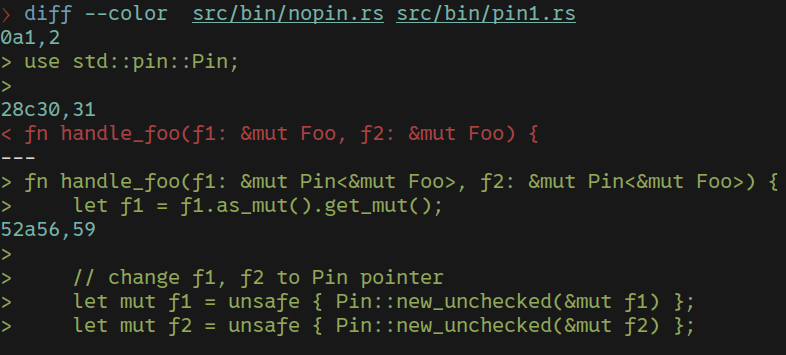
You see! It’s easy to introduce the Pin type to our code: Only change the signature
of handle_foo from &mut Foo to &mut Pin<&mut Foo>. And convert original pointer
to Pin pointer, i.e. shadow the original pointer as below,
let mut f1 = unsafe { Pin::new_unchecked(&mut f1) };At this phase, the check_invariant still can not pass. To prevent misuse of
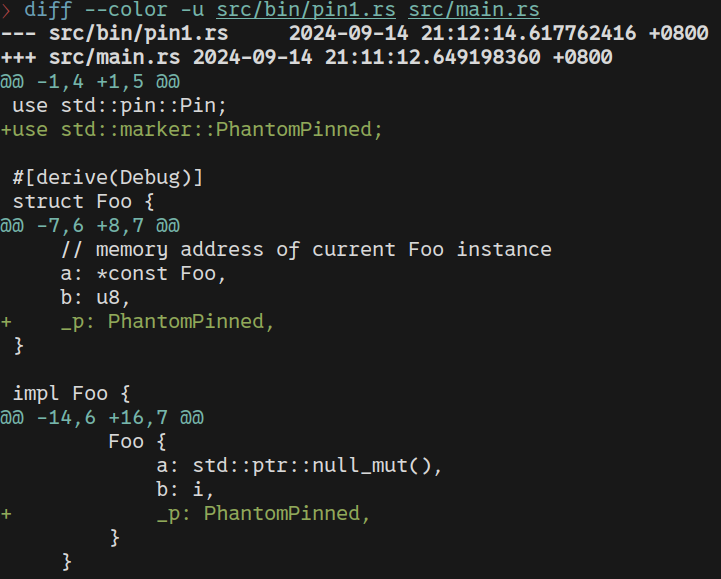
our struct Foo, we need make it !Unpin, i.e. we need disable auto trait
Unpin for struct Foo.