src/update.c
/*
** Process an UPDATE statement.
**
**   UPDATE OR IGNORE tbl SET a=b, c=d FROM tbl2... WHERE e<5 AND f NOT NULL;
**          \_______/ \_/     \______/      \_____/       \________________/
**           onError   |      pChanges         |                pWhere
**                     \_______________________/
**                               pTabList
*/
Reads:
TIP
- use ast-grep tool to search codebase if LSP is not working
FACTS
sqlite3_valuedata structure is used as registers store.
virtual machine
vdbe(Virtual Database Engine) trace
./sqlite3
> create table t(id int primary key, a int, b char(10));
> insert into t values (1, 2, 'hello');
> PRAGAMA vdbe_trace = 1;
> update t set a = 3 where id = 1;
instruction sequence:
┌─────┬───────────────┬────┬─────┬────┬──────────────────────────────┬────┬───────────────────────────────┐
│addr │ opcode        │ p1 │  p2 │ p3 │ p4                           │ p5 │  comment                      │
├─────┼───────────────┼────┼─────┼────┼──────────────────────────────┼────┼───────────────────────────────┤
│   0 │ Init          │  0 │ 18  │ 0  │                              │ 00 │ Start at 18                   │
│  18 │ Transaction   │  0 │  1  │ 1  │ 0                            │ 01 │ usesStmtJournal=0             │
│  19 │ TableLock     │  0 │  2  │ 1  │ t                            │ 00 │ iDb=0 root=2 write=1          │
│  20 │ Goto          │  0 │  1  │ 0  │                              │ 00 │                               │
│   1 │ Null          │  0 │  1  │ 2  │                              │ 00 │ r[1..2]=NULL                  │
│   2 │ Noop          │  2 │  0  │ 1  │                              │ 00 │                               │
│   3 │ OpenWrite     │  0 │  2  │ 0  │ 3                            │ 08 │ root=2 iDb=0; t               │
│   4 │ OpenWrite     │  1 │  3  │ 0  │ k(2,,)                       │ 02 │ root=3 iDb=0; sqlite_autoinde │
│   5 │ Explain       │  5 │  0  │ 0  │ SEARCH t                     │    │                               │
│     │               │    │     │    │ USING INDEX                  │    │                               │
│     │               │    │     │    │ sqlite_autoindex_t_1 (id= ?) │ 00 │                               │
│   6 │ Integer       │  1 │  6  │ 0  │                              │ 00 │ r[6]=1                        │
│   7 │ SeekGE        │  1 │ 11  │ 6  │ 1                            │ 00 │ key=r[6]                      │
│   9 │ DeferredSeek  │  1 │  0  │ 0  │                              │ 00 │ Move 0 to 1.rowid if needed   │
│  10 │ Rowid         │  0 │  2  │ 0  │                              │ 00 │ r[2]= rowid of 0              │
│  11 │ IsNull        │  2 │ 17  │ 0  │                              │ 00 │ if r[2]==NULL goto 17         │
│  12 │ Column        │  0 │  0  │ 3  │                              │ 00 │ r[3]= cursor 0 column 0       │
│  13 │ Integer       │  3 │  4  │ 0  │                              │ 00 │ r[4]=3                        │
│  14 │ Column        │  0 │  2  │ 5  │                              │ 00 │ r[5]= cursor 0 column 2       │
│  15 │ MakeRecord    │  3 │  3  │ 1  │ DDB                          │ 00 │ r[1]=mkrec(r[3..5])           │
│  16 │ Insert        │  0 │  1  │ 2  │ t                            │ 05 │ intkey=r[2] data=r[1]         │
│  17 │ Halt          │  0 │  0  │ 0  │                              │ 00 │                               │
└─────┴───────────────┴────┴─────┴────┴──────────────────────────────┴────┴───────────────────────────────┘
TIP
- The P1, P2, and P3 operands are 32-bit signed integers. These operands often refer to registers.
- P4 is a general purpose register and is used to store various kinds of data.
- P5 is a 16-bit unsigned integer normally used to hold flags. A flag register.
Lookup opcode in src/vdbe.c for instruction description, say:
case OP_Initcase OP_Transactioncase OP_Insertcase OP_Rowidcase OP_MakeRecord
ROWID
SQLite supports two types of tables:
- Regular Tables (WITH ROWID) - Default Have an implicit rowid: Every row has a unique 64-bit signed integer rowid Automatically generated: If you don’t specify a rowid, SQLite assigns one automatically Can be accessed: You can reference it as rowid, oid, or rowid Primary key behavior: If you declare an INTEGER PRIMARY KEY, it becomes an alias for the rowid
- WITHOUT ROWID Tables No implicit rowid: These tables do not have the automatic rowid column Explicit declaration: Created by adding WITHOUT ROWID at the end of CREATE TABLE Must have PRIMARY KEY: A PRIMARY KEY must be explicitly declared Primary key is the key: The PRIMARY KEY serves as the record key instead of rowid
virtual table
https://www.sqlite.org/vtab.html
/*
** Generate code for an UPDATE of a virtual table.
**
** There are two possible strategies - the default and the special
** "onepass" strategy. Onepass is only used if the virtual table
** implementation indicates that pWhere may match at most one row.
**
** The default strategy is to create an ephemeral table that contains
** for each row to be changed:
**
**   (A)  The original rowid of that row.
**   (B)  The revised rowid for the row.
**   (C)  The content of every column in the row.
**
** Then loop through the contents of this ephemeral table executing a
** VUpdate for each row. When finished, drop the ephemeral table.
**
** The "onepass" strategy does not use an ephemeral table. Instead, it
** stores the same values (A, B and C above) in a register array and
** makes a single invocation of VUpdate.
*/
static void updateVirtualTable;
An index is another table similar to the original “fruitsforsale” table but with the content (the fruit column in this case) stored in front of the rowid and with all rows in content order.
The general rule is that indexes are only useful if there are WHERE-clause constraints on the left-most columns of the index.
database file format
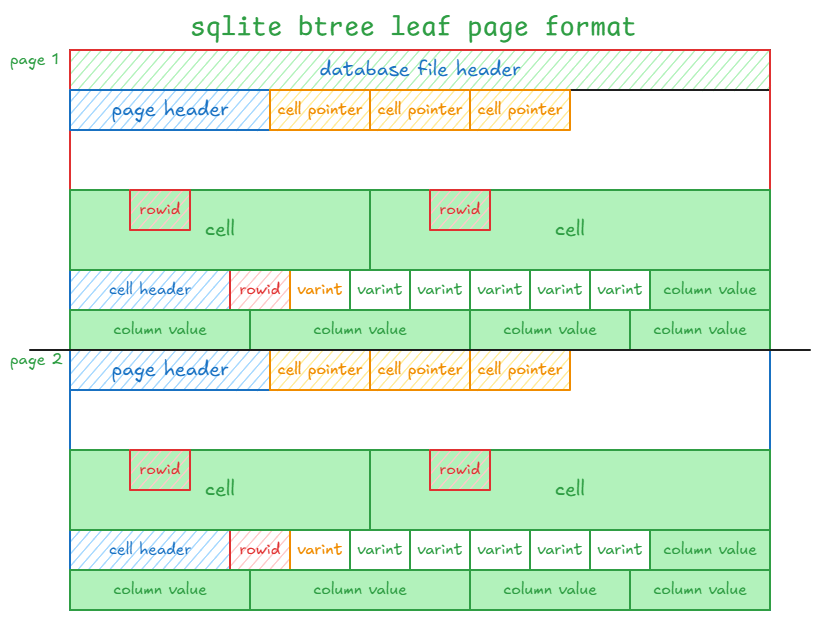
https://www.sqlite.org/fileformat2.html
see [src/btreeInt.h]
A database is a collection of btree pages.
varint
A varint (variable-length integer) is a compact encoding scheme used by SQLite to store integers using a variable number of bytes, depending on the integer’s value.
How Varint Works Varint encoding uses:
1-7 bits per byte for the actual integer value 1 bit per byte as a continuation flag Most significant bit (MSB) indicates if more bytes follow Encoding Rules Small integers (0-127): Use only 1 byte Larger integers: Use multiple bytes, up to 9 bytes maximum Each byte contributes 7 bits to the final value MSB = 1: More bytes follow MSB = 0: This is the last byte